
catamarans
Multi-Hulls
Catamarans are multi-hull vessels featuring two parallel hulls joined by a wide central platform.
Available in both sailing and power (motor) configurations, they have fundamentally shifted the yachting industry over the last decade. By splitting the volume across two hulls, catamarans completely eliminate the narrow, cramped layouts of traditional monohull boats. They offer a massive, open-concept main deck that seamlessly blends the interior saloon with the aft cockpit, creating a vast, single-level living and entertaining area.
Key Advantages
Exceptional Stability (No Heeling): Because of their wide footprint, catamarans do not “heel” (lean over) when sailing, and they resist rolling when at anchor. The boat stays flat, making walking around, cooking, and sleeping incredibly easy and comfortable.
Massive Living Space: A catamaran typically offers up to 1.5 times the living space of a monohull of the same length. The central bridge deck features huge panoramic windows, while the separate hulls provide excellent privacy for cabins, which are completely isolated from one another.
Shallow Draft: With no deep, heavy keel, catamarans can navigate into extremely shallow waters. You can drop anchor just feet away from secluded beaches and enter shallow reefs where single-hull yachts simply cannot go.
Efficiency and Speed: Power catamarans are highly fuel-efficient due to their narrow, easily driven hulls. Sailing catamarans perform exceptionally well on a reach (wind from the side), moving quickly with minimal drag.
Best Suited For
Families with Kids & Seniors: The lack of tilting, wide netting (trampolines) at the bow, and single-level living make them the safest and most comfortable option for children and older guests.
Seasickness-Prone Travelers: For anyone nervous about getting seasick, a catamaran’s stable, flat platform provides the most grounded experience you can get on open water.
Social Gatherings: Perfect for groups who want a casual, indoor-outdoor lifestyle, with plenty of separate zones (flybridge, forward cockpit, trampolines) for people to spread out.
What to Consider
Higher Marina Fees: Because they are nearly twice as wide as monohulls, catamarans take up more space and can be significantly more expensive to dock in crowded marinas.
Different Sailing Characteristics: They cannot sail as close to the wind (upwind) as a traditional monohull, and they require a different technique to maneuver in tight marina spaces.
Choose exactly what you need

SPACECAT


LONESTAR
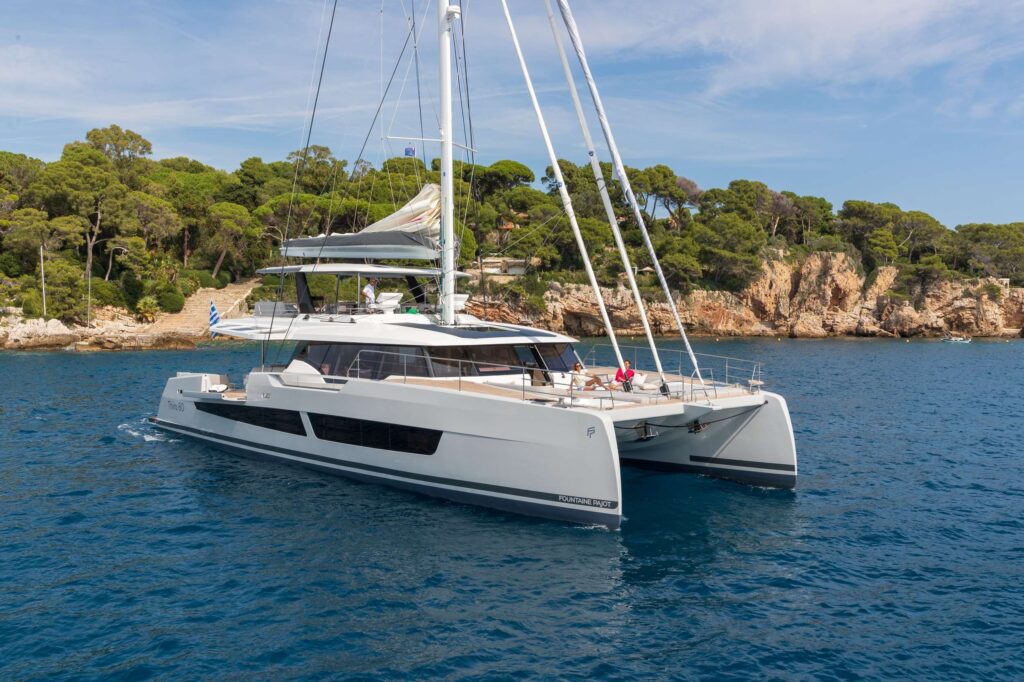
SOL MADININA
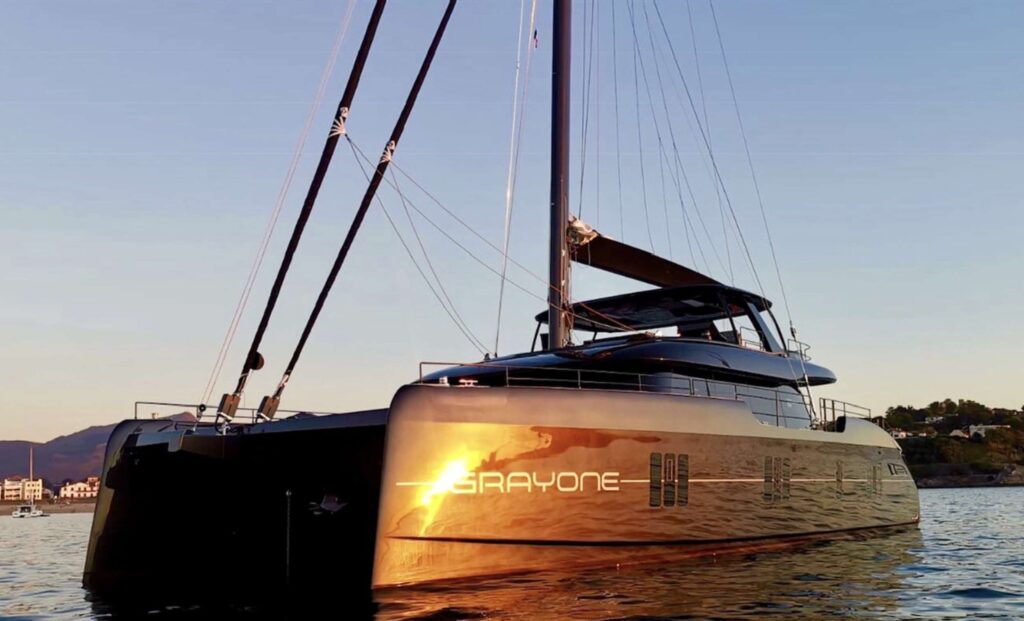
GRAYONE
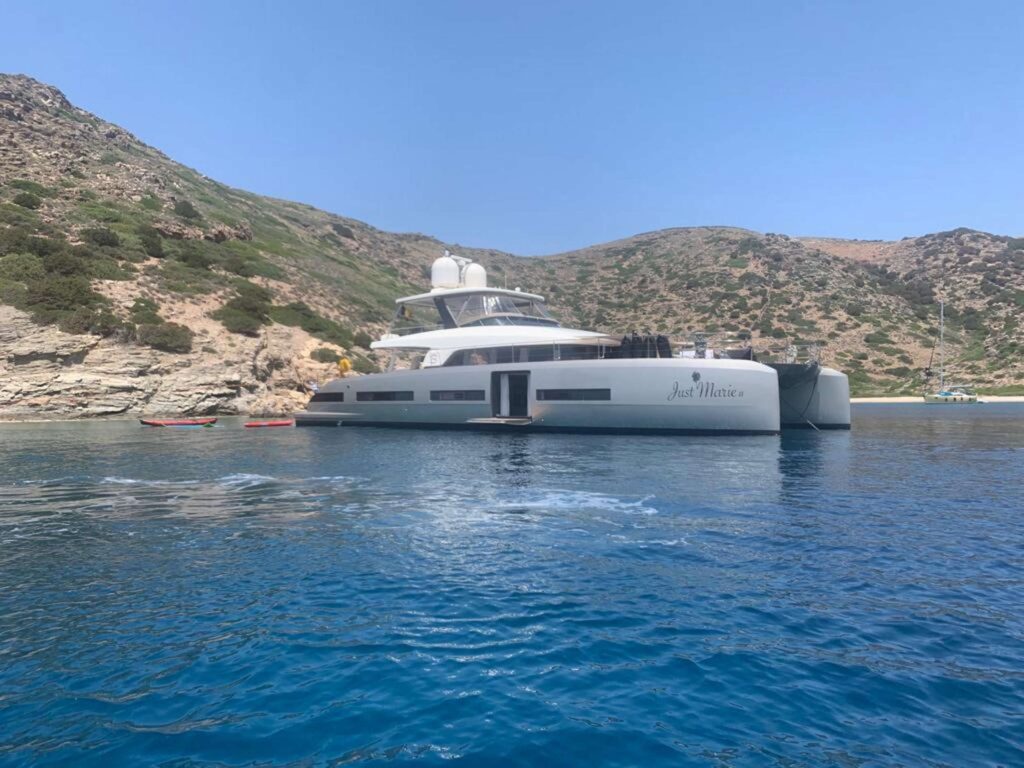
Just Marie 2
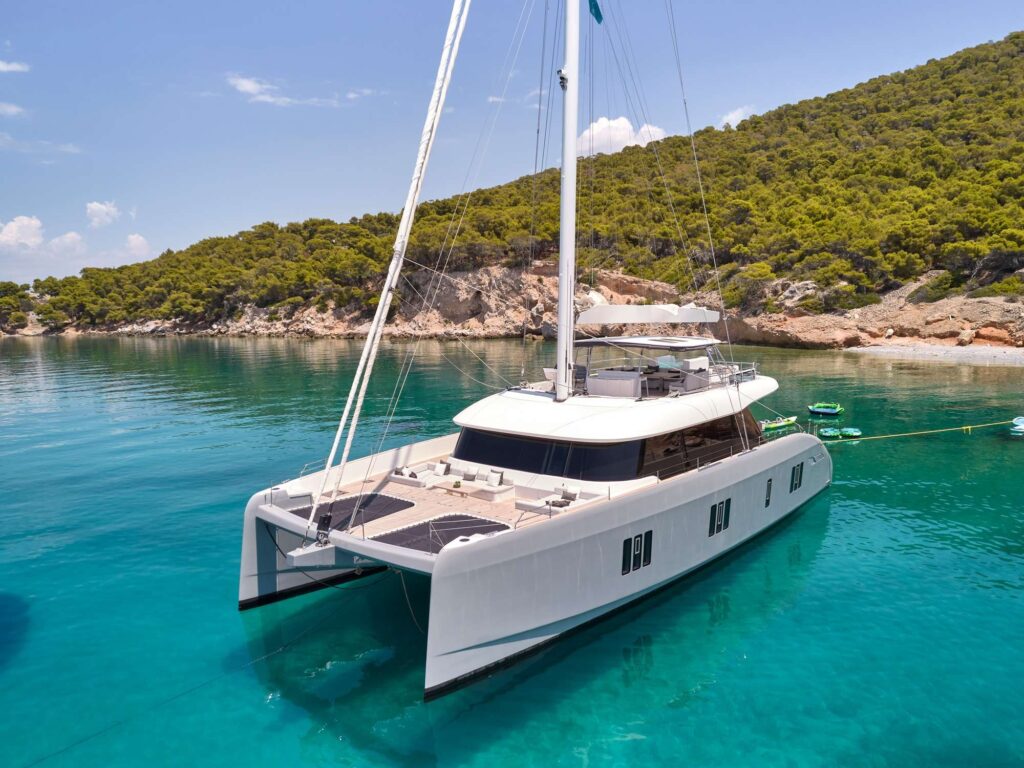
ABOVE & BEYOND

Spirit of ponant

Reve2Mer

BETWEEN

Eclipse
Send a direct request
FAQ
What is the minimum charter duration?
One day — and in my experience, it is more than enough to understand why people make yachting a habit. The format chosen by the overwhelming majority of our day guests is either a morning-to-afternoon run (typically 10:00 to 17:00) or an evening departure from around 17:30 through to after sunset. Both are complete experiences in their own right.
The daytime slot gives you proper swimming time, two or three anchorage stops, lunch served on board at anchor, and a relaxed pace through whatever bays the captain selects based on conditions that day. You’re not rushing between points — the idea is to slow down, get in the water, eat well, and return in the early evening feeling like you’ve actually been away.
The evening format is shorter but often the one guests remember longest. The light in the Mediterranean and Aegean from late afternoon onward is genuinely something else — the water shifts colour, the temperature drops just enough, and a cold drink on deck at that hour is difficult to argue with. It’s also the right choice for guests who arrive late in the day or want to combine a charter with dinner somewhere.
Some clients combine both slots and take the full day, which works particularly well for larger groups or anyone celebrating something. If you’re not sure which format fits, tell us what you’re after and we’ll advise honestly.
What is included in the charter price?
This depends on the charter format, so it’s worth being precise rather than giving a single answer that doesn’t
quite apply to anyone.
For a day charter — typically four to eight hours — the base price covers the yacht with full crew, fuel for the planned route, swimming stops and anchorages along the way, and standard soft drinks and ice on board. Lunch is usually available as an optional add-on and is almost always worth taking: the food prepared on a crewed day charter bears no resemblance to a packed lunch. Alcohol is generally bring-your-own or ordered in advance. If the trip is for a birthday, proposal, or any occasion worth marking, decoration and personalisation can be arranged separately.
For a weekly charter, the structure is more involved. You’ll be looking at one of two setups. The first is an APA format (explained in detail below), where a pre-loaded advance covers all running costs throughout the trip and is settled transparently at the end. The second is a fixed-package structure that includes the yacht, crew, a standard fuel allocation, basic provisions, and a defined cruising area — anything beyond those parameters is agreed and priced separately before departure.
The short version: a day charter is a clean, self-contained experience with minimal variables. A week charter is a full logistical operation, structured accordingly, and the price reflects that.
What is APA, and how does it work?
APA stands for Advance Provisioning Allowance. It is an amount paid on top of the base charter fee, loaded
before departure, and used to cover all running costs the yacht incurs during the trip on your behalf.
In practical terms, this means fuel — for the main engines, the tender, and the generator running overnight at anchor — along with all food and beverages on board, marina fees and port taxes wherever you stop, laundry, transfers, and any specific requests that come up during the week. If you want a particular wine, a delivery of fresh oysters mid-trip, or a transfer to meet someone at the airport, it comes out of the APA.
The standard amount is 30–40% of the charter rate, paid alongside your final balance before the charter begins. During the trip, the captain maintains a running record of every expense. At the end of the charter, you receive a full itemised breakdown. If there is a remaining balance, it is returned to you. If your group has spent over the amount loaded, you settle the difference — which in practice is a relatively small number when provisioned sensibly.
The reason this system exists and has become the industry standard is straightforward: it allows the charter to be genuinely personalised without requiring constant financial decisions on the water. You eat what you want, stop where you want, and run the trip on your own terms. Everything is accounted for, nothing is hidden, and at the end you have a clear record of what the week actually cost.
Guests who run a thoughtful APA — not extravagant, not artificially restricted — rarely come close to needing a top-up. Those who entertain heavily, cover long distances daily, or have strong preferences for premium provisions should load slightly higher and adjust accordingly.
■ If you are unsure how to set the APA level, share your planned itinerary and provisioning preferences with us and we will advise a realistic figure based on comparable charters.
What additional costs should I budget for beyond the charter rate?
Clients who have chartered before already know to factor these in. For first-time clients, it is better to be clear
upfront than to have a conversation about unexpected costs at the end of a trip.
Fuel is the most significant variable on motor yachts. Consumption depends on cruising speed, total distance covered, how long the generator runs at anchor each night, and tender usage. A faster passage between islands costs more than a slow day of bay-hopping. On a well-run weekly charter, fuel is tracked daily as part of the APA.
Marina and port fees vary considerably by location and time of year. A quiet anchorage costs nothing. A berth in a major marina during peak season — and especially during events like the Monaco Grand Prix or the Cannes Film Festival — can be significantly higher than the rest of the year. If your itinerary includes any high-profile ports during high-profile weeks, factor this in explicitly.
Crew gratuity is customary in this industry and is given at the end of the trip. The accepted benchmark is 10–15% of the charter rate. It is not contractually required, but it is standard practice across every serious market, and a good crew earns it.
My working rule for clients putting together a realistic total budget: add 35–40% on top of the base charter rate. It accounts for APA, gratuity, and the inevitable extras that come with a week on the water. Running slightly over is rare; being caught short is more uncomfortable.
■ On MYBA-format charters, all of the above is documented and reported. On fixed-package or bareboat charters, agree everything in writing before departure.
What are the crew gratuity conventions?
Gratuity is the part of chartering that clients sometimes feel uncertain about, so it is worth explaining clearly.
Ten percent of the charter rate is the accepted standard across the Mediterranean, Aegean, Caribbean, and most other major charter markets. On vessels where the service has been exceptional — and on a well-crewed superyacht, it often is — fifteen percent is not unusual. On a day charter or shorter format, a flat amount based on your honest assessment of the experience is appropriate.
The tip is given on the final day of the charter, typically as a cash envelope passed to the captain, who then distributes it among the crew based on roles and contribution. Some clients now transfer directly, which is equally accepted. The entire crew — stewardesses, chef, engineer, deckhands — shares in the gratuity, not just the captain.
The crew is aware that gratuity is not contractually guaranteed. Which is precisely why the good ones earn it every day of the charter, and why it should reflect that honestly.
How do I choose between a motor yacht, sailing yacht, and catamaran?
These are genuinely different products, not just different shapes. The choice depends on what you want the
charter to feel like.
A motor yacht covers distance efficiently, maintains its speed across most sea conditions, and typically offers more interior volume per metre than a sailing boat of equivalent length. Air conditioning is reliable, the layout tends to be more hotel-like in its comfort, and the itinerary is less dependent on weather patterns. If your priorities are covering ground between islands, consistent comfort, and a certain level of status on the water, a motor yacht is the right call. The tradeoffs are higher fuel costs and, on some routes, an engine-heavy background hum that some guests notice more than others.
A sailing yacht is slower and more dependent on wind and conditions, but for the right client that is exactly the point. There is a rhythm and atmosphere to sailing that a motor boat simply does not replicate — the silence when the engine is off, the heel of the boat, the sense of actual travel rather than transit. Running costs are meaningfully lower. Cabins are generally tighter and the boat moves more at sea, which matters for guests who have never sailed before. I always ask new sailing clients to think honestly about their sea legs before committing.
A catamaran sits between the two in several respects. Deck space is generous — the wide platform and netting forward give a catamaran a social feel that neither a motor yacht nor a monohull quite matches. Stability at anchor is excellent, which is particularly appreciated by guests with young children or anyone prone to motion sensitivity. The shallow draft opens up bays and anchorages that a deeper-keeled yacht cannot access. On the practical side, catamarans take up more space in marinas and often pay accordingly, and the sailing dynamics are different — less sporty, more stable.
My standard question when a new client is genuinely undecided: do you want to arrive somewhere, or do you want to travel there? The answer usually settles it within one follow-up question.
■ If you are chartering as a group with mixed preferences, a catamaran is frequently the most diplomatic choice — the space and stability suit almost everyone.
Do the yachts have stabilizers, and does it matter?
It matters considerably for some guests and not at all for others. The honest answer is that stabiliser availability varies by vessel, and it is worth checking before you sign rather than discovering the situation once you are offshore.
On motor yachts over 20 metres, stabilisers are common but not universal. The two main systems are fin stabilisers, which activate while the yacht is underway and reduce roll during passage, and gyroscopic systems — brands like Seakeeper being the most widely fitted — which work both underway and at anchor. Guests who are sensitive to motion will find the gyro systems noticeably more effective, particularly when the yacht is sitting in a swell overnight.
Catamarans do not need stabilisers. The twin-hull design distributes displacement across a wide beam, which produces a naturally stable platform — especially at anchor, where most guests sleep. This is one of the genuine practical advantages of the catamaran format for families and guests who are not experienced sailors.
Monohull sailing yachts are built to heel and roll — it is fundamental to how they move and how they sail. Stabilisers are rarely fitted and would in any case conflict with the basic mechanics of the boat. Very large sailing superyachts (35 metres and above) sometimes carry advanced stabilisation systems, but these are exceptions.
If motion is a concern for any member of your party — particularly children or elderly guests — flag it when you inquire. It narrows the vessel selection appropriately and avoids a mismatch that is difficult to fix once you are at sea.
Can I charter a yacht without crew?
You can, and there is a real market for it — but it suits a specific type of client and requires the right qualifications.
Most charter companies and insurers require a valid offshore certificate — RYA Yachtmaster, IYT Master of Yachts, or an equivalent qualification — plus a logbook showing relevant sea miles for the class of vessel and cruising area. Some jurisdictions require a local boating licence in addition to your international credentials. Insurance is mandatory and must name you as the skipper. In certain countries and protected cruising areas, a local guide or licensed captain must be on board regardless of your qualifications.
Beyond the paperwork, bareboat chartering suits guests who genuinely want to handle the yacht themselves — who find the practical work of sailing or operating the boat part of the pleasure rather than an inconvenience. If that is your intention and your logbook supports it, it works well.
For everyone else, the case for taking a professional captain is strong and becomes stronger the less familiar you are with the specific waters. A good captain does not just drive the boat. He knows which anchorages hold well in the prevailing wind, where the hazards are that aren’t on the chart, when to push on and when to stop, and how to manage an unexpected situation at sea without it becoming an incident. That knowledge is built over years in a specific cruising ground and is genuinely difficult to replicate from a chart table.
A crewed charter is not a compromise. It is a different product — one where you are a guest on your own trip, rather than responsible for it.
How does catering work on board?
On a fully crewed charter, all meals are prepared on board by the yacht’s chef. Before the charter begins, we collect a detailed preference form covering dietary restrictions and allergies, cuisine preferences, disliked ingredients, preferred wines and spirits (including specific brands where it matters to you), and any meals you would like to eat ashore rather than on board.
The chef provisions based on this form before departure — fresh produce, proteins, dairy, beverages, everything. On APA-format charters, all provisioning costs are drawn from the advance and reported at the end. You are not paying for meals separately on the day.
The quality of the food is one of the things guests mention most consistently after a trip, and not as an afterthought. A capable chef with access to fresh local markets — fish bought directly from morning boats in Turkey, octopus and sea urchin landed the same day in Greece, produce from farmers in the Croatian islands — produces meals that are difficult to replicate on land, let alone in a restaurant. Guests who take the preference form seriously tend to eat better on a one-week charter than they do in an average month at home.
Meals can be served wherever you want — on deck at anchor, in the saloon if the weather turns, at a table set up on the beach if you’ve stopped somewhere that allows it. The format is entirely at your discretion. Most guests settle into a rhythm by day two: coffee and breakfast as the boat moves, swimming before lunch, lunch at anchor, and dinner on deck once the sun is down.
For guests with specific dietary requirements — vegan, kosher, halal, severe allergies, medical dietary restrictions — these need to be communicated clearly before the charter starts, not on the morning of departure. The chef can accommodate almost anything with adequate notice and the right provisioning.
Can we dive or fish during the charter?
Both are standard activities on a crewed charter and both are worth planning in advance rather than deciding on the water.
For diving, the key questions are whether the yacht carries equipment on board and whether there is a licensed instructor or divemaster available — either as part of the crew or arranged locally. Some vessels in Turkey and Greece come equipped for diving as a default; others require rental equipment to be brought on board before departure. Certain marine protected areas require a certified guide and in some cases a permit. For guests who are not yet certified, a Discover Scuba session can generally be arranged through a local dive centre at whichever base you are starting from.
Popular dive areas in our core operating regions: in Turkey, Kekova, Kas, and the Bodrum peninsula offer submerged cities, cave systems, and underwater arches. In Greece, the Dodecanese and Cyclades have excellent visibility and varied terrain. Sites that are genuinely inaccessible from shore — reachable only by sea — are one of the real advantages of diving from a charter yacht.
For fishing, formats range from trolling for tuna and dorado offshore to slow coastal fishing for sea bass and grouper. A good local guide who knows the productive grounds on a specific stretch of coast is worth arranging — particularly for offshore fishing, where local knowledge about current lines and seasonal movement makes the difference between a day on the water and an actual result.
On both counts, specify what you want at the inquiry stage. We confirm what is included on the specific vessel, what needs to be organised separately, and what the permit and licensing situation is for your planned itinerary.
Can I smoke on board?
On designated areas of the open deck, with prior agreement — yes. In cabins, the main saloon, the galley, or any enclosed or covered space — no, without exception. This is not a preference or a house rule. It is a fire safety requirement and it is consistent across the industry regardless of yacht, owner, or charter company.
The reasoning is straightforward: a yacht is a sealed floating environment with fuel tanks, gas lines, upholstered interiors, and limited access to emergency services if something goes wrong. Charter insurance typically excludes fire damage related to smoking in prohibited areas, and professional captains take this seriously.
Some owners are stricter than others about smoking even on deck — particularly on yachts with teak decks, light upholstery, or no designated outdoor smoking area. If smoking is a meaningful consideration for your group, mention it at the inquiry stage and we will filter vessels accordingly and confirm the specific conditions in writing before the charter agreement is signed.
■ Electronic cigarettes and vaping are generally subject to the same restrictions. When in doubt, ask the captain before the trip, not during it.
How do children manage on board, and what should we prepare?
Children who spend time on the water at a young age tend to adapt quickly and often thrive on it. With the
right planning, a crewed charter with children is straightforwardly enjoyable rather than stressful.
When you inquire, provide the ages and number of children on board. Life jacket sizing requirements vary, and we need to confirm the vessel carries appropriate sizes before you arrive. Charter companies and captains who work regularly with families are accustomed to this — it is a standard question, not an unusual one.
Itinerary planning matters more with children than without. Long open-water crossings in moderate sea conditions, with no stops and no easy way off the boat, are not ideal for children under ten. Bay-hopping itineraries with frequent anchorages, short passages, and swimming opportunities multiple times a day work much better. A captain who knows the waters can build an itinerary with children in mind without sacrificing the quality of the trip for adults.
Some clients travelling with young children bring a nanny or professional childminder. On a weekly charter, this is a genuinely sensible option — it gives children dedicated attention and gives adults the ability to actually relax. It is one of those things that sounds like an extravagance but, by day three, everyone on board agrees it was the right decision.
Medical considerations should be communicated clearly before the charter. Motion sickness medication for children should be discussed with a doctor in advance, particularly for younger guests and passages in open water. If any child has a condition requiring specific medical equipment or access to regular care, this needs to be factored into the itinerary planning.
Can pets come on board?
Some owners permit pets and some do not — there is no industry-wide position, and the answer depends entirely on the specific vessel.
When a yacht does allow pets, the conditions are typically: written confirmation in the charter agreement, the guest assumes full liability for any damage or additional cleaning required, and the guest is responsible for full compliance with the veterinary documentation, microchip registration, and import/export requirements of every country the yacht visits. On a multi-country itinerary, these requirements can be significantly more complex than expected — quarantine rules, health certificates issued within specific time windows, and species-specific restrictions vary considerably between EU countries, Turkey, and destinations further afield.
Practically speaking: dogs that are comfortable on boats, have sailed before, and respond reliably to commands in an unpredictable marine environment (passing vessels, unexpected wakes, wildlife) are manageable. Dogs that have not been on the water before, or that are anxious, or that need space they will not have, are a risk to themselves and to the comfort of everyone else on board.
Flag it at the initial inquiry. We will identify which vessels in our network permit pets, confirm the exact conditions in writing, and advise on the documentation requirements for your specific itinerary before any agreement is signed.
What safety equipment is carried on board?
Commercial charter yachts are subject to flag state inspection and must meet defined safety standards before they are permitted to operate. The required equipment is not optional and is verified at survey.
As a minimum, every crewed charter yacht must carry: correctly sized life jackets for all persons on board plus reserve, an inflatable life raft rated for the number of guests and provisioned with emergency supplies, throwable buoys with self-activating lights fitted from the stern and sideboards, a fully stocked and current first aid kit, fire extinguishers serviced to current certification in staterooms, galley, and engine room, VHF radio maintaining a watch on Channel 16, flares and visual distress signals within expiry date, functioning navigation lights and sound signals, and AIS transponder for position identification.
Larger vessels and those operating offshore additionally carry EPIRBs (Emergency Position Indicating Radio Beacons), satellite phones, and man-overboard recovery systems. Superyachts frequently carry defibrillators and more advanced medical equipment.
Before departure, the captain is required to conduct a safety briefing for all guests. This covers the location and use of life jackets, the location of the life raft and how to deploy it, man-overboard procedure, fire procedure, and general emergency protocols. It takes roughly ten minutes and is not a formality — on a professionally run charter it happens every time, regardless of whether guests have chartered before.
If you want to confirm specific equipment before booking — defibrillator, advanced medical kit, crew first aid certification level — ask us and we will verify with the captain directly. For guests with specific medical conditions or those travelling to remote areas, it is a reasonable and professional thing to request.
What happens in the event of bad weather or force majeure?
The captain makes the decision on whether and how the yacht moves, and that decision is final. No client preference, planned itinerary, or schedule overrides a safety call at sea. This is maritime law, professional ethics, and simple common sense — and any captain worth the qualification operates this way without exception.
In practice, serious weather that prevents a charter from operating at all is relatively rare in the main Mediterranean and Aegean season. What is more common is weather that requires the itinerary to adapt: moving to a sheltered coast instead of an exposed one, anchoring behind a headland rather than in an open bay, spending a day in a well-equipped marina rather than at sea. A good captain plans for this, knows the alternatives in any given cruising area, and presents a modified plan rather than an explanation of why nothing is possible.
Some of the strongest guest feedback we receive is about days that went differently from the plan — a sudden decision to duck into a bay nobody had heard of, a day in a port that was supposed to be a brief fuel stop but turned out to have an extraordinary fish market, a passage rerouted south that put the boat in front of a clear sunset from a direction nobody expected. Flexibility and local knowledge frequently produce better outcomes than a fixed itinerary rigidly executed.
For serious disruptions — a technical failure that prevents the yacht from departing, or a weather event that genuinely makes the charter unviable for an extended period — the charter agreement governs. On MYBA-format contracts, force majeure provisions are legally defined and cover what happens in those circumstances. We act in the client’s interest within the bounds of the agreement and the applicable maritime law, and we are transparent about that from the start.
■ Build genuine flexibility into your itinerary. Guests who arrive at the marina with an open mind about exactly where the week takes them consistently report better trips than those with a port-by-port schedule they are unwilling to adjust.